We have recently done a long project that began with some lectures about the future, and what developments might be coming along as benefits and challenges for the generation now in their teens.
We did a lot of research, using a wide range of sources on the internet to try to get an idea of what the big issues are. Group members then wrote essays on their findings.
SH wrote about the coming of Artificial Intelligence. I looked at the societal changes that may result from social media, automation and the collapse of the job market for many types of worker. In later parts of his essay, SH borrows from discovered text, showing the breadth of his reading.
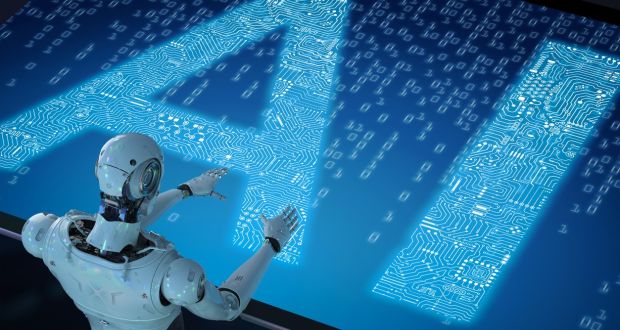
ARTIFICIAL
INTELLIGENCE IN THE FUTURE: SH
The ‘well-known’ Artificial
Intelligent, so called AI is a general name for those machines or robots that
has its own mind that’s been set up by us, which makes them different, or
smarter, than other normal machines that can only follows certain orders that
human makes. Now because of the technology is developing in a rapid speed,
especially in those categories that requires a relatively high level of new
developments, and AI is the one that’s developing the fastest in all of them,
also where people are focusing the most at.
The development also brings us a big
distribution about whether this is positive future to look at or not. Far before
the AI industry has anything that is actually working, a lot people had already
started the idea of it can be a big problem for us, because they thinks that
machines should never have their own thoughts like we do, but they can only
follows what we told them to do, or they might turn their back on us when they
think they are smart enough to do that. This can even lead to the total
destruction of human beings or the shift of power on the scale of the entire
planet. This thoughts has spread with a tremendous speed through the Medias,
internets, a lot of them even comes from entertainments such as movies and
games, or novels about our dark future of becoming the slaves of robots.
The scientists obviously has a
different thoughts than average people like us. They mostly thinks that AI is
going to bring us into a much brighter future which they can help us do all the
rough works, so we can just be lazy watching TV while our intelligent robot
does everything for us, and we can all be fat and anti-social.
Many factors could significantly
accelerate or decelerate the development for AI, and honestly we haven’t
discover most of them yet. These include – but are explicitly not limited to: Increasing
difficulty of new breakthroughs. Progress in science depends not just on
funding available and the effort put in, but also on how ‘hard’ progress is;
some fields see the difficulty of further discovery increase with each
successive discovery. AI may prove to be one such field, where recent advances
are essentially ‘low-hanging fruit’. Indeed, this ‘intractability’ is sometimes
considered to apply to some key subfields of AI already, such as natural
language processing or long-term automated planning. There may also be a
natural or operational ‘ceiling’ to the intelligence available to neural
architectures (even non-biological ones), resulting in diminishing returns of
research and an eventual, ‘slowdown’ of our progress towards human-level
intelligence. Eventual hardware limitations. On a related note, it is
possible that along with conceptual and software limits, we may also reach
fundamental physical limits to our hardware: while previous predictions to this
effect have not been borne out, it is possible that before long we will reach
an end to Moore’s Law, and this will slow progress towards AI. For instance, in
2004, the “serial speed” version of Moore’s Law broke down, and the overall
trend in computing power growth was only preserved by making a transition to
parallel processors. While this for the moment preserved Moore’s Law, it raised
new difficulties for software developers. Overall, the formulation of Moore’s
law which has the most economic relevance, computations per dollar,
continues to hold, but it is unclear how much longer this will continue before
hard physical limits assert themselves, in a way that cannot cost-effectively
be addressed through other innovations. A breakthrough in cognitive
neuroscience. Conversely, while it is currently difficult to map and
understand the cognitive algorithms behind human intelligence, new tools,
methods or even concepts might enable cognitive neuroscientists to achieve a
quantum leap in understanding how the human brain gives rise to its own
intelligence, in a way which might allow AI scientists to recreate that
mechanism in an artificial substrate. Human enhancement. More
speculatively, human cognitive enhancement technologies could make researchers
(and with them whole academic networks) more effective via cognitive
enhancement pharmaceuticals, brain-computer interfaces (the so-called ‘neural
lace’), or genetic engineering for cognitive traits, speeding up the rate of
AGI research, and the exchange of lessons and breakthroughs, at least within
communities and companies. Quantum computing. Having overcome early
hurdles and barriers, the next developments in quantum computing nonetheless
remain difficult to predict; it is also unclear whether or not breakthroughs in
this field could contribute (or conversely, might be necessary) to creating and
running advanced AI. However, at present it appears that even if built, a
quantum computer might provide dramatic computing speed improvements – but only
for specific applications. A ‘Sputnik event’ creating large development
incentives. The 1957 Soviet launch of Sputnik demonstrated to the world the
possibility of space flight – and to the US the possibility of an accurate
Soviet nuclear ballistic missile arsenal. The resulting aspirations to explore
and claim space, and the fears over a ‘missile gap’, together sparked a space
race between the superpowers, with unprecedented and long-term funding for
space projects on both sides. If there is a similar “Sputnik moment” for AI,
which demonstrates in a vivid or compelling way that human-level (or
smarter-than-human) AI is possible or even imminent, this can drive a sharp
race towards the finish line, especially since the winner of this race could
reap tremendous economic, scientific, military and geopolitical rewards. Societal
collapse – or existential catastrophe. Political, economic, technological,
or natural disasters may cause a societal collapse during which progress in AI
would be essentially stalled or even reversed. There is a growing body of
scientific literature that argues that the risk of extreme, global catastrophes
deserve increasing attentions from both researchers and policymakers. This
literature distinguishes between 54 Artificial Intelligence and the Future
of Defence
‘Limited’
Global Catastrophic Risks (GCRs)—loosely defined as “risks
that might have the potential to inflict serious damage to human well-being on
a global scale” —and absolute ‘Existential Risks’ threats
that could cause our extinction or destroy the potential of Earth-originating
intelligent life”. Such threats, which can include natural risks such as
meteorite strikes, volcanic winter, or pandemics as much as anthropogenic catastrophes
such as the threat of (inadvertent) nuclear winter or (with advances in synthetic
biology) engineered pandemics. These are extreme tail events which, by their nature,
would be hard to predict or prepare for.
Societal distrust and disinclination. Less
severely, but still problematic, is the potential for societal disruptions,
even if falling short of ‘global catastrophic risks’, to inhibit technological
development. Indeed, some have suggested that ultimately the greatest barrier
to the development of AI could be society. As AI systems become ever more
powerful, as they automate away more and more human jobs, create pervasive inequality,
or if such systems end up used for comprehensive and intrusive government surveillance,
some societies may question whether it is wise to create machines more powerful
than themselves. Already today, there is a growing international movement against
lethal autonomous weapons systems, under the banner of the ‘Campaign
to Stop Killer Robots’. While the track record of
societies willingly relinquishing strategically powerful technologies is hardly
promising in this, or perhaps chequered at best, the potential disruption
caused by advanced AI systems in economies or in war could be visceral enough
for enough people that it strengthens the public case of possible ‘AI abolitionists’.
This
last point of societal distrust is relevant as it relates to broader caveats we
should bear in mind in the development and deployment of machine intelligence.
If the development of AI, and its introduction into society, is rushed or
mishandled, public concerns over technological unemployment, machine bias,
automated surveillance or computational propaganda can and will create critical
legitimacy problems, driving public distrust of, and even societal backlash
against AI. Therefore, even if we may still be some time from developing ‘full’
or ‘general’ AI, it is important that we now already think about the legal and
ethical implications, and consider measures for the responsible supervision,
regulation, and governance of the design and deployment of AI systems – all the
while keeping in mind that this is not a zero-sum game, and AI can, on balance
and if handled properly, be a beneficial technology with innumerable positive
applications. Thus we might meet the call, by prominent AI researchers, to also
commit to the “careful monitoring and deliberation about the implications of AI
advances for defence and warfare, including potentially destabilizing
developments and deployments.” In doing so, policymakers can take stock of the
influential long-and short term research priorities set out by AI experts in
the 2015 open letter on “Research Priorities for Robust and Beneficial
Artificial Intelligence”; or the principles of guiding ethical research and
design, ensuring integrity of personal data and individual access and control,
as well as economic and humanitarian issues, as recently set out by the
Institute of Electrical and Electronics Engineers (IEEE) in their study on
‘Ethically Aligned Design: a Vision for Prioritizing Human Well Being with
Artificial Intelligence and Autonomous Systems.’ Perhaps most importantly, we
must keep in mind the ‘AI Principles’ agreed to by AI experts at the recent
landmark ‘Asilomar Conference on Beneficial AI.
For conclusion: I personally think that the AI industry is a really
deep and dangerous industry to be focusing at, again it can lead to some
consequences that we could never fix. Still it has a lot to develop even
despite from the fact it’s developing really fast, there are both advantages
and disadvantages about what might happen next, I guess we will just have to
wait and see, hoping that humanity knows what they are doing.
AC wrote about the pressures on world ecosystems, and what is already being described as the sixth great mass-extinction of life on Earth.
Introduction
Here is a question.
Is the Earth is suitable for us to live on? My answer would be yes and no. We
are such an intelligent creature on Earth, you may understand that the world
seems to be alright to you or us. In fact, things change themselves slowly. Too
slow that we can’t even feel the change in the start. Then here comes out a new
question. What is happening? Yes, one of the most powerful words ‘what’ has
guided us to think what is going on around us. What on Earth is changing?
This passage is
going to talk about what disasters have happened and what could happen in the
future. What is the cause and what made us end up facing these problems.
- The great extinct ( the 6 )
The Sixth Great Mass Extinction (Ron Wagler)
We all know what the
word extinct means, but what does The great extinct or Extinction event mean?
It is a time period that animals or creatures suddenly died in large number.
For example, the First extinction event ‘Ordovician-Silurian extinction event’.
Approximately 25% of the families and nearly 60% of the genera of marine
organisms were lost because of fluctuations in sea level, extensive glaciations
and global warming [1] . The world ‘global warming’ is one of the reasons why
we are taking this seriously, It has been related to a lot of problems that
might deeply effective to our survival.
Every year,
thousands of old people die in summer because of heatwave. We might think it is
because the condition problems, but have a think about it. Have you ever felt
that every year is getting hotter than
the year before? This is because the greenhouse gases have been created more
and more by human activity. Greenhouse gases originally control the heat energy
not letting some of it get out from the Earth’s atmosphere. We use to have a
suitable amount of greenhouse gases in the atmosphere until the time that our
technology started to change. By the time that human invented tool such as
plane, car, boat etc. We have been using fossil fuel as the fuel for those
tool. Firstly it seem to be alright, but in reason years. We started to know
that how greenhouse gases affect the atmosphere. More and more gases trap the
heat energy in the atmosphere and creating hot wave to a lot of place like U.S,
China, Philippines other countries etc. Every year creature continuously
suffering the heat and die because of the enormous changing of the climate. A
research from WWF shows that the sea levels rising, ocean temperature getting
warmer and longer & more intense droughts threaten crops, wildlife and
freshwater supplies. For example, climate change has some impact with sea
turtle that sand temperature might too hot for the turtle eggs and sea levels
might rise too high and damage the turtle nest. Even more , turtle might lose
their birthing habitat.
As we have
mentioned, problems from fossil fuel not only causing the heat wave but also
create acid rain, change the ocean temperature and acidity. This may cause some
serious problems that some of the fish species may go to other ocean area. It
might unbalance the food chain on the local fish species and cause extinction
of ocean creature. On the other hand, carbon dioxide which is one of our well
known greenhouse gases may combine with rain drops. It would create acid rain,
damage building, forest and river etc.
Even our or animal hair cells could be damage. Firstly,
those animals that rely on trees would lose their shelter and reproductive
places. Insect and aquatic life-form would be killed. On us, we would lose our
resource from frost, farm and ocean.
Building that we had made would be corroded by the rain. Soon we are no
longer to live on the surface of the Earth with no food and water supply for
every creature.
Recently, scientists
have made a theory that every day, UN Environment Programme said that in 2018.
There were 150 - 200 species of creatures would become extinct in one day. This
result has proved that human being might have made a huge problems with
decreasing the number of creature by every kind of purpose. Hunting is one of
the most usual things that cause the problems. For example, dodo birds. They
have been hunted to extinct because of
the taste of it. In the mid-to-late 17th century, when people arrived on
the island of mauritius. They brought their hunting pet into the island and
started their killing spree.finally, this action cause the dodo extinct. For
another example, by the deforestation continue in all over the world. Forests
cover 31 percent of Earth’s land surface and house a majority of plant and
animals found on earth. It is estimated that these diverse ecosystems house 80
percent of the world’s terrestrial biodiversity. Rainforests have especially
high special density, covering 2 percent of the earth’s surface, but housing
nearly 50 percent of all plant and animal species. But forests are often cut or
burned to make for farming or cattle grazing. Commercial logging also
contributes to deforestation, and forest are cut down for development.
Deforestation in developing nations is primarily due to a competitive global economy,
where poorer countries sell their natural resources to pay their debts to
wealthy countries. The poor in these countries also utilize the land for
farming and sustenance, and these pressures continue to increase as population
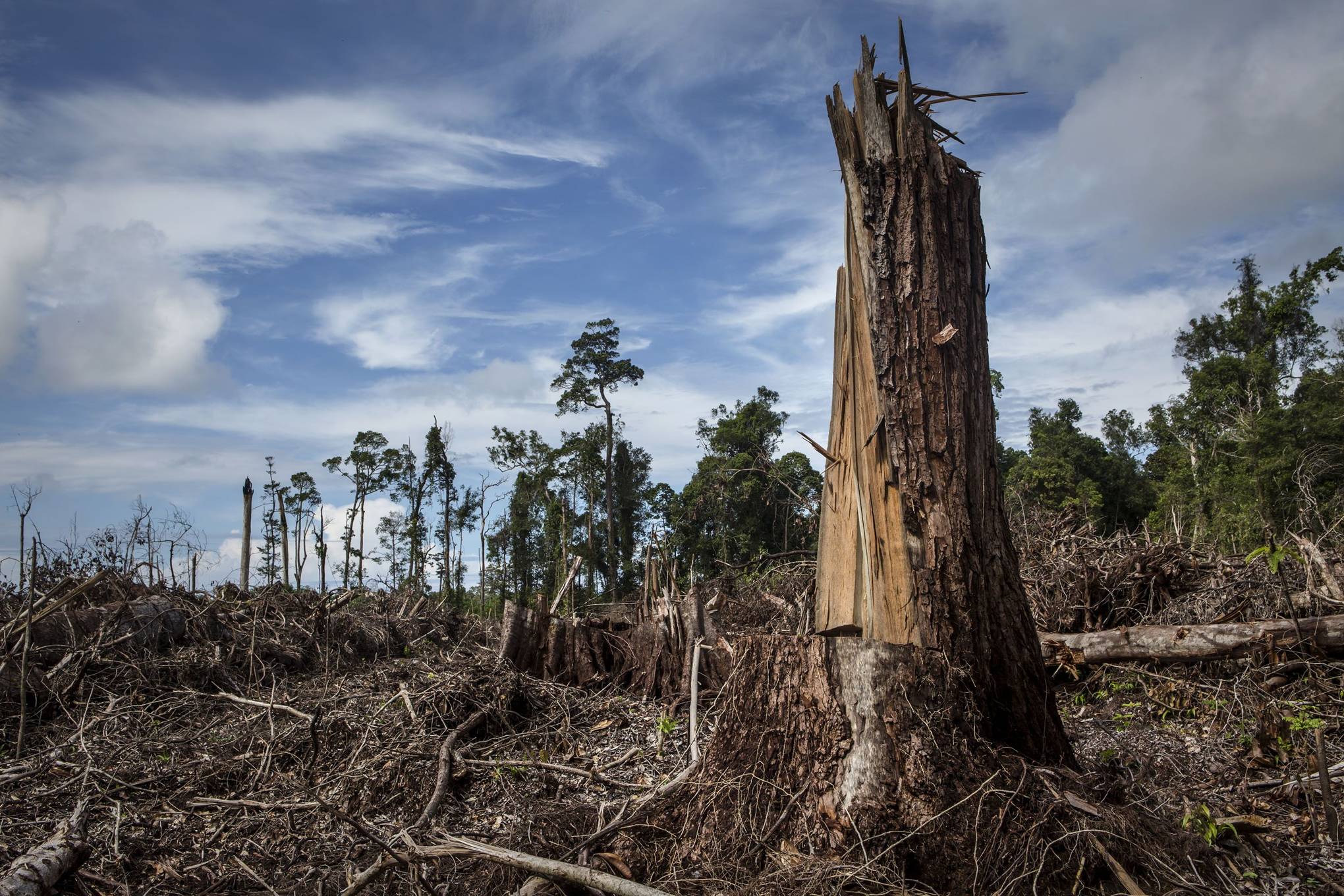
levels increase. Here is a thing call ‘clear-cutting’. It can be particularly
devastating to forest ecosystems, especially in rainforest ecosystems.
Rainforest deforestation negatively affects the whole ecosystem because the
clear-cut land is much more vulnerable to soil erosion when no trees remain to
hold the soil in place.
[2]The most affected
regions are the Amazon Rainforest, Sumatran Jungles, and forests of British
Columbia. These forests have been specifically target for deforestation for a
few reasons, but overall for human gain. The amazon rainforest is being clean
cut at a rate of 20,000 square miles per year and mostly to create more land
for farming and pastures for cattle ranching. Sumatran rainforests are being
destroyed and replaced by massive palm plantations to help feed human obsession
with palm oil. Canada’s British Columbia is a hotspot for old growth forests
that contain some of the most sought-after lumber the world.
These examples are just a few of the most publicized areas
dealing with the problem of deforestation and there are many less well known
regions being just as dramatically affected. On the other hand, come back to
the impact to animal.
Deforestation has
real consequences
for animals. The most serious impacts of deforestation on animals are habitat
loss, changing climate, higher risk of wildfires and droughts, starvation,
increased interaction with human. Deforestation can lead to a direct loss of
wildlife habitat as well as a general degradation of their habitat. The removal
of trees and other types of vegetation reduces available food, shelter, and
breeding habitat. Wildlife habitats become fragmented, where native species
must live on remaining habitat islands that are surrounded by disturbed land
that is being used for agriculture and other uses.
Habitat fragments may be too
small to maintain viable populations of animals, and an animal living in one
population may no longer be able to freely breed with individuals in other
populations. Animals may not be able to find adequate shelter, water, and food
to survive within remaining habitat. Animals may also encounter dangerous
situations such as increased human-wildlife conflicts and being hit by vehicles
when they attempt to migrate between habitat fragments. With increased habitat
edge, wildlife may experience an increased vulnerability to predation,
poaching, wind, sunlight, invasion of exotic plant and animal species into
remaining forest habitat, and other factors such as direct exposure to natural
disasters that were not as much of a threat prior to the deforestation event.
Some animal species are entirely dependent upon old growth forest habitat, such
as the Northern Spotted Owl in the Western United States, and cannot survive in
secondary forest habitat. This means that in places where is any deforestation
happening, these species cannot thrive and will gradually disappear.
For climate changing, Because forests store a large amount of the
world’s carbon dioxide, deforestation contributes 15 percent of global
greenhouse emissions. When forest trees are burned, the carbon that they were
storing gets released into the atmosphere. Climate change leads to new weather
patterns, changing levels of precipitation and temperature fluctuations . These
climatic changes can have many negative impacts, not only on local populations,
but also on wildlife populations around the world as global climate change
alters the habitat they depend on. Have a
think, we have been to their home to cut tree. It could increased interaction
with both of us and animals. Generally, wildlife interaction with us is
negative and can have disastrous consequences for the animals. One of the best
examples of our problematic co-existence with large carnivores are wolves.
Wolves, once the most widely distributed mammals in the world, were for
centuries regarded as our worst enemy for hunting our livestock.
The
great extinction - Extinction of creature / forest
The conflict get so far that
wolves were extensively hunted down and became a rare sight in many areas of
the world. Finally, we need to know that Deforestation has dramatic effects for
all animals, whether they live in rivers, oceans, forests, mountains, or skies.
The most affected group of animals are those
that are endemic to a specific area or ecosystem, which is directly or closely
linked with the forest. This represents animals that are adapted only to their
specific habitat. They are often found in remote and isolated areas, like on
islands or deep in the rainforest. Very specialized animals fill a single niche
found in an ecosystem. Sometimes the niche is so specialized that it is only
found in a small region, like a single lake or one square kilometre of forest.
 Through this research
or thing. I think we need to have a think what we have done. As I wrote a few
pages before. I have said that the extinction, would cause a lot of life form
to die. Nowadays, what is changing like deforestation or something. It seem to
be showing that the coming up new extinction is coming. Although it would take
longer time to finish than other extinction. Still, if you have a look, you
might know that the extinction is already started and it is lead us to end. All
of the problems it seems to been started on us. We change everything by our
activity and it seems that we are too late to fix these problems.
Through this research
or thing. I think we need to have a think what we have done. As I wrote a few
pages before. I have said that the extinction, would cause a lot of life form
to die. Nowadays, what is changing like deforestation or something. It seem to
be showing that the coming up new extinction is coming. Although it would take
longer time to finish than other extinction. Still, if you have a look, you
might know that the extinction is already started and it is lead us to end. All
of the problems it seems to been started on us. We change everything by our
activity and it seems that we are too late to fix these problems.
~End~
HN wrote about the impact of Robots on her home society in Japan.
My future project
My
aim of this project
Nowadays, a lot of
kinds of scientific technologies are advanced, and our lifestyle has been
changed. Although we can get many things which make us comfortable and our
lives more convenient, we have some disadvantages such as getting worse eye
sight, problems between friends caused by social media and the disruption of
our circadian rhythm by a smart phone or computer. Additionally, we have become
very international in the world. We need some new skills, for example, speaking
foreign language especially English. From these things, I am interested in how
our life will be changed. Hence, my aim of this project is to know about our
jobs in the future and now they will be different from currently.
The
future of our jobs
Do you know lots of
kinds of scientific technologies such as robots, and AI (artificial
intelligence) have become dramatically common in the last few years? With
virtual reality and digital personal assistants the picture is even more
complicated. It is said that there are three types of dislocations that may
occur to most of any jobs in the world. They are digitalization,
automation and robotization.
Digitization –
Digital transformation will be used in all fields of industry in the near
future. “Digital” means turning things that humans used to do
physically into virtual versions. Amazon
is an effective example that indicates the digital revolution. We don’t need to
go to a store. Everything is done at via browser, and delivered to our home.
Uber and Gett are more recent examples of digitalization. All we need to do is
just press a button, and then a car comes to our location and the ride is
already paid for via the application.
Automation – the
process allows humans try to do tasks as simply as possible through the use of
technologies in order to improve and increase efficiently. A few examples of
automation from thousands years ago are the plough, the wheel, the yoke,
harness and the spindles. Nowadays, automation is used in a factory to
activate, execute, monitor and control processes, products, or services, and
the delivery. The next things to be automated will be cars and drones.
Robotization –
this is the latest technology development from recent advances; cloud
computing, artificial intelligence, engineering, and data analysis. Robots can
be said to be “simple” automation because they help us to arrange information
and manufacture. There are some kinds of robots in multiple areas. For
instance, humanoid robots; some of them offer an assistance to care for older people
as a caregiver robots. Others are robots for military use. A third kind is
software-only robots called “chatbot.”
These three revolutions will lead to improvements in our
lives. They will have a big effect on our advanced societies, emerging markets
and less developed countries.
On the other hand, plenty of jobs will disappear a few
decades later. Since I’m very interested in what kinds of jobs will be lost by
digitalization, automation and robotization, I am showing you with some questions.
There are nine questions divided into three groups;
First group is
1, Did your job/profession exist before World War 2?
2, Are these many others like you that do the exact same
job, in your organization or in others?
3, Do you have an association or unions for your
job/profession?
If you answered “yes” to all three questions, then
your job will disappear in the near future and it will be digitized or robotized.
If you answered “no” to one or more questions , you
go another questions of next group.
1, Does your job require a higher-education degree?
2, Do you need to employ creativity in your job?
3, Does your work require the interaction and collaboration
with others inside your organisation?
If your answer was “no” to all three questions, then your
job will be automated or chatbotized.
If your answer was “yes” to one or more questions, you go
questions of the last group.
1, Does your job require you to have a routine or work
according to a specific method, template, or standard?
2, Will your job be affect if another job you work with is
automated, robotized or digitalized?
3, Does your job act as an intermediary between other job in
a process or activity?
If you answered “yes” to all three questions, then your job
will be automated or digitalized.
If you are still answering “no” to any of three questions,
the job you want to do in the future or your skills to engage your job are
required. But, I cannot guarantee that you will able to get your work obviously.
(These are from an article of Tomer Simon, PhD. It was
written 16th June in 2017)
Therefore we need to re-think of the state of our future
society, and economy and politics change. We have the right to live a happy
life, so we have to save the things that make life good. The reconsidering of jobs,
and the connections between government and citizens will be very important. We
have an opportunity to create a new system for living and to development a new
sort of politics to deal with the economic disruption that is coming. If almost
of our jobs in are digitized, automated or robotized, politicians will be
concerned about how to prevent a circumstance which society is under the
control of robots or intelligences and it might be complicated. However, there
are some suggestions to help people to solve the transition from an industrial
socialise to a digitalised society and economy. The strategy for employees in
the future will be include activities of volunteering and to spend their own leisure
time usefully. The meaning of “jobs” will have a wide range. The definition is no
longer people’s sense of personal meaning, but also multiple activities. All we
are required to do for the future is getting skills which robots or
intelligences can’t be substituted into, such as traditional craftsmanship,
obtaining a high communication skills which make people feel better or solve
their mental problems, and developing their capabilities.
The
Fourth Industrial Revolution
There are several things which speed up the introduction of
the scientific knowledge, human health, economic growth and more. They are the
Fourth Industrial Revolution. But it has possibility that the revolution could
cause that robots and computers can perform many human jobs as a source of
significant personal concern.
The four industrial revolution is what leads society
changing completely by technologies.
The first industrial revolution was powered by a major
invention such as steam engine. It enabled us to produce in a different route
more effectively. We became able to manufacture in a factory.
The second industrial revolution was mass production with
steel, oil, and electricity. The key inventions were a light bulb, a telephone
and an internet combustion engine.
The third industrial revolution was the invention of the
semiconductor, personal computer and the internet marked. Those inventions are
also called “Digital Revolution”
The four industrial revolution occurred a long pause after
the third one. It was fairy different to the previous three one. One of the
reasons is it has a gap among the digital, physical and biological world. The
other one is the technology is changing extremely quicker than ever. The evidence
to prove that how fast the technologies are advanced is “Pokemon Go.” The 100
million users had access to it in less than one month by contrast the case of
the telephone which spent 75 years to get an exactly same amount of people. It
was spreading at an incredible rate. Augment reality, 3D printing and artificial
intelligence for the operation are major technologies that enormously affected
us, especially companies.
Nowadays trying to think separately of “tech” and “non-tech”
has lost necessarily. However, there are some people who have not noticed it.
In fact, many companies, the government and citizens cannot keep up to this
such a fast speed of change of circumstances.
From a president of an association, “technology” is defined
that “the betterment of humankind.” It is said that all technology produce more
jobs than it destroy, bring valuable benefits to us, give us the higher level
of lives and produce an effective productivity and economic growth. Yet, there
is a lot of fear about, not only for individual livelihoods, but also for the
stability of society as change happens dramatically in many areas. We cannot
avoid this outcome. If we want to have advantages from latest technology, we
have to stand up with actions right now. We must expect what will be happened
in the future.
Technology, automation and AI will bring benefits as well as
threats to our way of life.
The advantages to us is being supplied a top quality and
industry-relevant skills. Innovative online programmes are for example. We will
get them at a chain management, many universities, and MIT. They give us a
traditional higher education in low price. Additionally, “continuous uptraining”
is an important factor according to industry experts with sophisticated experiences
of digital and problem-solving skills. Teachers who are considering how to support
the future of their pupils agree. The system which allow all employees to spend
significant time in some span produces fresh skills and become an essential
tool to help individuals to adapt a big change. Finally the most surprising
effect is we could be able to get higher salary in a shorter working time,
because automation and robots can deal with tasks quickly and can increase
proactivity.
On the other hand, we have some disadvantages from the
automation. The largest problem for us is that plenty of jobs will disappear.
The graph above indicates which kind of jobs are becoming
automatable. The category of jobs with which interact people and need the high
education and much knowledge will still be required. By contrast, most service
industries will be automated. Checkout
assistants, leisure and there park attendants etc.
In fact, 25.3% of jobs is already disappearing between 2011
and 2017 in England. Especially women have got a big threat because most of
them are doing part-time working. Almost all jobs in this field such as
checkout assistants, receptionists and doing paper works have been automated.
They have 70.2% of high possibility disappearing. Indeed, a few years ago,
Amazon opened a supermarket in Seattle with all automation. No staffs, just “walk
out” technology to bill customers and queues.
From those factors, hundreds of employees will lose their
jobs. Robots have much better skills. Accuracy, effectively and sophisticated
are for instance. Unfortunately, we can’t get those skills as well as them and
also can’t have trainings to absorb those skills.
In addition, we have “winner-take-all economy.” If it
happens, a differentia between rich and poor will be broadened. Workers who
have high skills can work with a good salary, on the other hand, others are
struggled with the way to be succeed and will be one of the most important and
the most difficult problems to solve. It will be remained as an issue.
To change the future to a good direction totally, we need a
great effort as the society, as the same field of an industry. Finding
long-term of solutions is the goal.
What automation will transform our jobs, our lives and our
society is obvious. However, all of jobs are not a target and whether it gives
us benefits or bad effects is up to us. A super prioritise for everyone is to
enjoy the cheerful and healthy stable lives. Since everybody has right to live
in society, it is important to get an opportunity and challenge to use our time
effectively. If we know latest advancing technologies well, it might help you to
certain our future is not going to the end and we have way to prevent from
damaging. Actually we have become engaged in defining the current problems and
forecasting challenges very closely, as well as looking for the country which can
develop or solve problems collaboratively. For instance when a disaster or a military
problem happens. It promotes to build a future in which technologies work for
everyone.
Human
beings VS AI
In this topic, I will introduce some robots which do exactly
same things that people are doing.
Firstly, let’s meet a Japanese robot called “Tourobo Kun.”
Recently it took the entrance exam to get into Tokyo University. This is the
top and hardest to get into university in Japan. “Tourobo Kun” took the paper four
times, but it could not get a score high enough to gain a place at the
university. It could get only limited score in the exam. It needed good reading
comprehension in Japanese and English, but did not have it. By contrast it
always got high scores in maths or science exams.
The second one is “alpha Go.” This robot won in “Go”
competitions against humans even though people believed that robots would never
win against people in this game. “Go” is very similar to chess. It needs the
ability to plan what to do next to win, but there are many more moves that
could happen next. In addition, it is also required an ability to take a broad
view. Therefore when it won, a lot of
people got a shock. This robot has been developed and getting even more
intelligence now.
The third one is a translation robot. There was a big competition in 2017 to decide
which is more sophisticated at translation, humans or robots. Four people whose
occupations were translator and three new AI robots were played against each
other. The result was an overwhelming victory for people. Robots were not able
to consider the context and to understand how people were feeling, what meaning
behind the words, and they had limited range of knowledge of professional areas.
However they can translate much quickly than people.
The
living of the future style
Our life links closely with our jobs and industry, so the
way we live in the future will obviously change. Do you know it is said that
Japan is already living in the future? Hence, I illustrate some objects in
Japan.
Smart toilet-
this is used especially at the nursing home or in the hospital. It can check
our blood pressure, urine, protein, weight and body fat at the same time when
we use this toilet. It can tell us a lot about our inner health.
Smart mirror –
this mirror can notices winkles, redness, pores and sun damage and offers a
range of suitable products when it addresses us.
The Archelis Chair-
this is comfortable seats especially for surgeons who need supports during long
surgeries. It covers around the legs and buttocks. It was made to relieve pain
of pressure on the back, feet and legs with limited moving.
Those are the machines used especially in the hospital or
nursing area.
Home robot- some
of them can work as a housewife. They can cook, clean the room and so on.
Hotel robot- they
help reception. They can speak foreign languages and lead guests to their rooms.
Some hotels already use these robots as a receptionist.
Conclusion
Our lives and society have changed rapidly than we image.
Digitalisation, automation and robotization are one of the biggest factors
which affects our jobs directly. The Fourth Industrial Revolution is a turning
point in the history of an industry. However we need to notice that robots and
AI can deal with things that have programmed in administratively without any
feeling and emotion. They do not have ability to think what you are feeling. They
can show answers or results of the problems but they cannot explain the process
by getting them. We should admire to all processes because a lot of clues and
new discoveries are hidden. Therefore we should have talents which only human
being can do and we have responses to find out the facts. It is said that to survive
in the future, we have to get skills which robots or artificial intelligence
cannot substitute in. Yet, I believe gaining those skills is quite hard for us.
Consequently, I suppose we should have three kinds of abilities. One is an
ability to think proactively, not reactively. Second one is calming down and then
judge the situation. The last one is flexibility to response to various
problems or circumstances.

No comments:
Post a Comment